Colorado · typical $250–$700
Tree roots in sewer lines
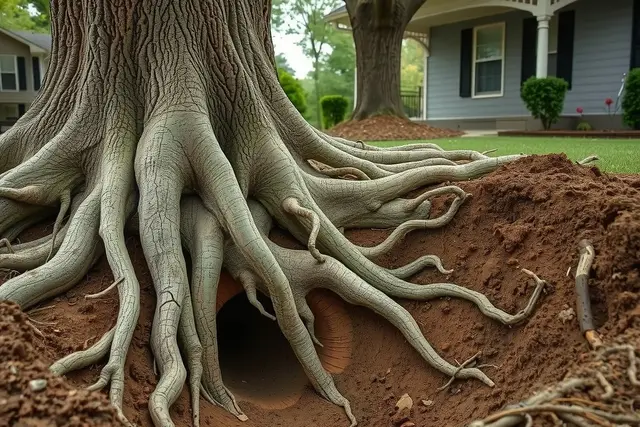
Roots don't break into sound pipe. They find a joint that's already weeping a little moisture, slip in as hair-fine strands, and grow into a mat that catches everything flushed down the line. In older Colorado neighborhoods with big street trees and clay sewer laterals, it's the most common reason a main line keeps backing up.
Need tree root removal help?
Answered 24/7
Including holidays and storms
Licensed local plumbers
Licensed in Colorado
Winter-ready
Frozen lines and thaw calls
Price ranges up front
Know the range before they come
Sounds like this?
- The main line backs up every spring or every year or two
- Roots came out on the drain cable last time
- A large tree within 20 to 30 feet of the sewer path
- Slow drains throughout the house in late summer
- Gurgling toilets when the washer drains
Why roots are a Front Range problem
Denver, Fort Collins, Greeley, Boulder and the older parts of most Front Range towns were planted with fast-growing, water-seeking trees: cottonwoods, silver maples, Siberian elms and willows. Many of the same neighborhoods have clay sewer laterals in short sections joined every few feet. In a dry climate, a leaking joint is one of the most reliable sources of water a root can find.
Cut, jet, or repair?
| Option | What it does | When it makes sense |
|---|---|---|
| Root cutting | A cutting blade on a cable shears roots off at the pipe wall | First backup; fine to moderate roots |
| Cutting + jetting | Cuts, then scours remaining root hair and debris | Heavy roots, repeat backups |
| Root treatment | Foaming herbicide applied in the line after cutting | Slows regrowth; ask the plumber if it's allowed and suitable |
| Spot repair or lining | Seals the joint roots are using | Same spot keeps failing; pipe still sound elsewhere |
| Lateral replacement | New PVC line | Many failing joints, breaks or collapse |
Keeping roots out longer
- Schedule cutting before the season your line usually backs up, not after.
- Get the line scoped after cutting so you know whether you're dealing with one bad joint or a whole failing lateral.
- When planting, keep new trees well away from the sewer path; a plumber can mark where it runs.
- Don't cut down a healthy tree before you know the pipe's condition. A lined or repaired pipe and the tree can coexist.
Common questions
How do I know if roots are in my sewer line?+
Repeat main line backups, especially in spring or late summer, and roots on the drain cable are the usual signs. A camera inspection confirms it.
How often do roots grow back?+
Often within one to two years after cutting, because the joint they used is still open. Repairing or lining that joint is the long-term fix.
Do I have to remove the tree?+
Not necessarily. Repairing the joint or lining the pipe usually stops intrusion without losing the tree.
Is root removal covered by insurance?+
Usually not; root intrusion is treated as maintenance. Some policies cover resulting water damage. Check yours.